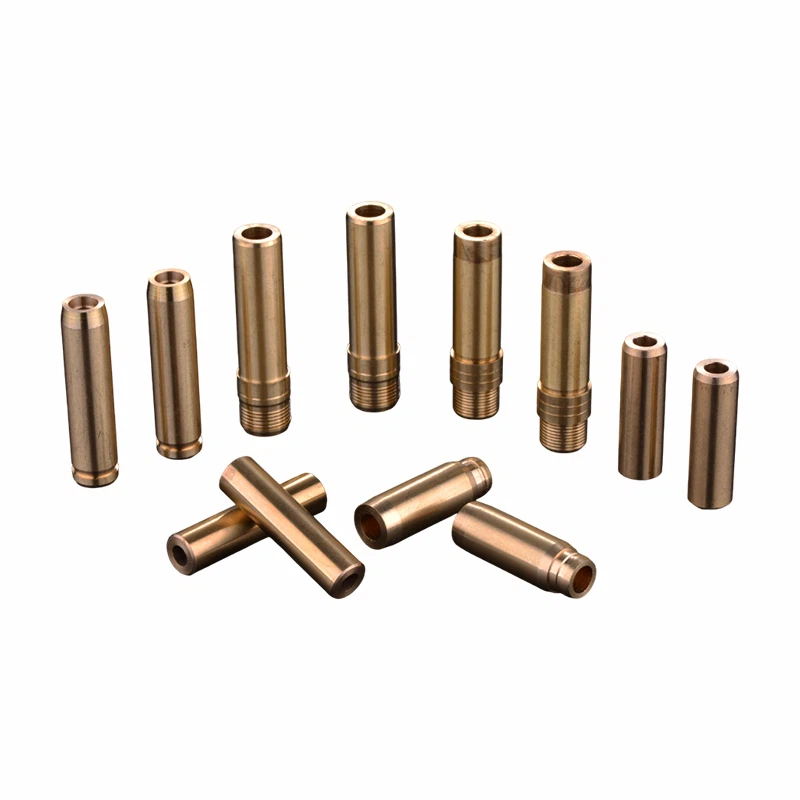
Hey there! As a supplier of Bronze Round Tube, I've gotten tons of questions about the magnetic susceptibility properties of these tubes. So, I thought I'd dive deep into this topic and share some insights with you all.
First off, let's understand what magnetic susceptibility is. In simple terms, it's a measure of how much a material will get magnetized in an external magnetic field. It can be positive or negative, and that tells us a lot about the material's behavior in a magnetic environment.
Bronze is an alloy mainly made up of copper and tin, with sometimes a few other elements thrown in for good measure. Copper, which is a major component of bronze, is diamagnetic. That means it has a negative magnetic susceptibility. When you put copper in a magnetic field, it creates a weak magnetic field in the opposite direction of the external field. Tin, on the other hand, is also diamagnetic, but its magnetic susceptibility is a bit different from copper's.
Now, when we talk about bronze round tubes, their magnetic susceptibility is influenced by the exact composition of the bronze. Different ratios of copper and tin, as well as the presence of other elements like zinc, lead, or phosphorus, can change the overall magnetic behavior of the tube. For example, if a bronze alloy has a higher percentage of tin, its magnetic susceptibility might be slightly different compared to a bronze with less tin.
One of the cool things about bronze round tubes is that their diamagnetic nature makes them useful in a bunch of applications where you don't want magnetic interference. For instance, in some electrical equipment, magnetic fields can cause all sorts of problems, like signal distortion. Since bronze round tubes are diamagnetic, they can be used to shield sensitive components from external magnetic fields.
Another area where the magnetic susceptibility of bronze round tubes comes into play is in scientific research. Scientists often use materials with known magnetic properties to study magnetic fields and their effects. Bronze round tubes can be used as a reference material in these studies because their magnetic susceptibility can be accurately measured and controlled.
Let's compare bronze round tubes with Bronze Round Bar and Bronze Shaped Tube. While the basic magnetic susceptibility properties are similar because they're all made of bronze, the shape can have an impact on how the material interacts with a magnetic field. A round tube has a different surface area and volume distribution compared to a round bar or a shaped tube. This can affect the way the magnetic field penetrates the material and how the induced magnetic field is distributed within it.
In a round tube, the magnetic field lines might have a different path compared to a solid round bar. The hollow center of the tube can create a sort of "shielding" effect, where the magnetic field is less likely to penetrate the inner part of the tube. This can be useful in applications where you want to protect something inside the tube from a magnetic field.
When it comes to measuring the magnetic susceptibility of bronze round tubes, there are a few methods. One common way is to use a magnetometer. This device can measure the magnetic field around the tube and calculate the magnetic susceptibility based on the changes in the field. Another method is to use a SQUID (Superconducting Quantum Interference Device) magnetometer, which is a very sensitive instrument that can detect even the smallest changes in magnetic fields.
Now, I know some of you might be wondering about the practical implications of all this. Well, if you're in an industry that deals with magnetic fields, like electronics, telecommunications, or scientific research, understanding the magnetic susceptibility of bronze round tubes can help you make better decisions about which materials to use. For example, if you need a material that can resist magnetic interference, bronze round tubes could be a great choice.
If you're in the market for high - quality bronze round tubes, I'd love to chat with you. Whether you have questions about the magnetic properties or just need some advice on which type of bronze is best for your application, I'm here to help. Just reach out, and we can start a conversation about your specific needs.
In conclusion, the magnetic susceptibility properties of bronze round tubes are fascinating and have a wide range of applications. Their diamagnetic nature makes them valuable in many industries, and the ability to control their composition allows for tailored magnetic behavior. If you're looking for a reliable supplier of bronze round tubes, don't hesitate to get in touch.


References:
- "Introduction to Magnetism and Magnetic Materials" by David Jiles
- "Handbook of Magnetic Materials" edited by Klaus H. J. Buschow