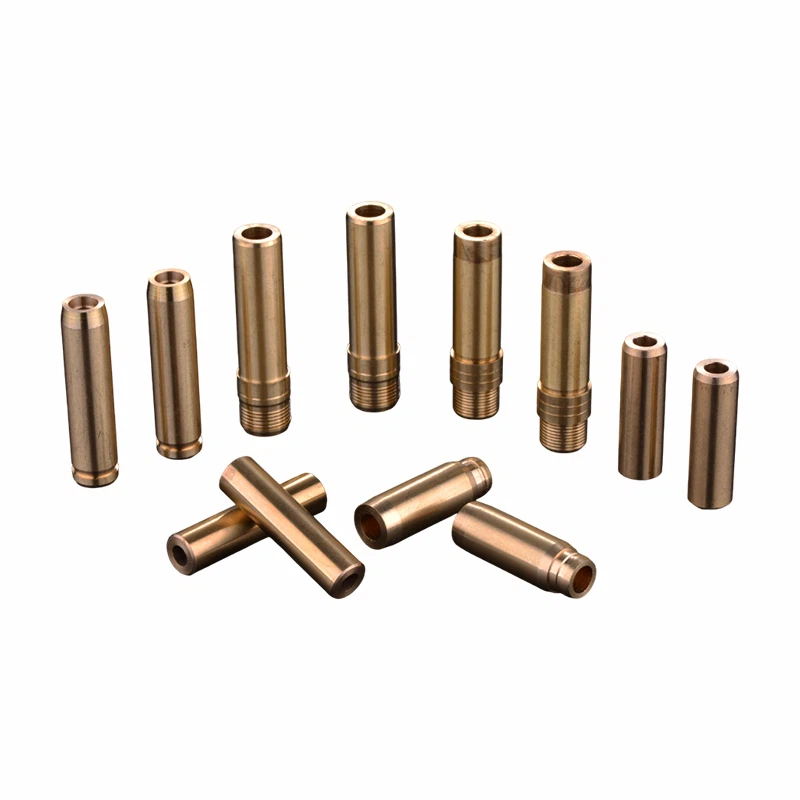
Bronze alloys have been used for thousands of years due to their excellent combination of properties, including strength, corrosion resistance, and good casting characteristics. One important aspect of bronze alloys that is often overlooked is their creep properties. Creep is the slow and progressive deformation of a material under a constant load over time, and understanding the creep behavior of bronze alloys is crucial for applications where long - term stability and dimensional accuracy are required. As a bronze alloys supplier, I am well - versed in the creep properties of these materials and will share some insights in this blog.
Understanding Creep
Creep occurs in three main stages: primary, secondary, and tertiary. In the primary creep stage, the deformation rate decreases with time. This is because the material undergoes work hardening as it is deformed. The secondary creep stage is characterized by a constant deformation rate, which is often referred to as the steady - state creep rate. This stage is the most important for long - term applications, as it represents the long - term behavior of the material under load. The tertiary creep stage is marked by an accelerating deformation rate, which eventually leads to failure.

Factors Affecting Creep Properties of Bronze Alloys
Temperature
Temperature has a significant impact on the creep properties of bronze alloys. As the temperature increases, the atomic mobility within the alloy also increases. This allows dislocations to move more easily, leading to a higher creep rate. For bronze alloys, elevated temperatures can cause the material to soften, reducing its ability to resist deformation under load. For example, at room temperature, a bronze alloy may have excellent creep resistance. However, when exposed to temperatures above 300°C, the creep rate can increase significantly. This is a critical consideration for applications such as bearings in high - temperature machinery or components in heat - treating furnaces.
Stress Level
The applied stress is another key factor influencing creep. Higher stress levels will result in a higher creep rate. In bronze alloys, the relationship between stress and creep rate is often non - linear. At low stress levels, the creep rate may be relatively slow, but as the stress approaches the yield strength of the alloy, the creep rate can increase exponentially. For instance, in a bronze [Bronze Shaped Rod](/copper - alloy - material/bronze - alloys/bronze - shaped - rod.html) used in a structural application, if the stress due to the load exceeds a certain threshold, the rod may start to deform over time, compromising the integrity of the structure.
Alloy Composition
The composition of bronze alloys plays a vital role in determining their creep properties. Different alloying elements can have various effects on the atomic structure and dislocation movement within the alloy. For example, adding small amounts of elements such as tin, aluminum, or nickel to a copper - based bronze alloy can improve its creep resistance. Tin forms solid solutions with copper, which can strengthen the alloy and impede dislocation movement. Aluminum can form intermetallic compounds that act as barriers to dislocation motion, thereby reducing the creep rate. On the other hand, impurities in the alloy can have a negative impact on creep properties. For example, sulfur can form low - melting - point compounds that can promote creep at elevated temperatures.

Creep Testing of Bronze Alloys
To accurately assess the creep properties of bronze alloys, specialized testing is required. Creep tests typically involve applying a constant load to a specimen at a specific temperature and measuring the deformation over time. The test can be carried out for an extended period, sometimes for thousands of hours, to obtain reliable data on the long - term creep behavior.
There are different types of creep tests, such as constant - load creep tests and constant - stress creep tests. In a constant - load creep test, a fixed load is applied to the specimen, and the change in length is measured as a function of time. In a constant - stress creep test, the stress on the specimen is maintained at a constant level, and the strain rate is monitored. These tests provide valuable information about the primary, secondary, and tertiary creep stages of the bronze alloy.

Applications and Creep Considerations
Bearings
Bronze alloys are commonly used in bearing applications. In bearings, the material is subjected to continuous loads over long periods. Creep can cause the bearing to deform, leading to increased clearances, reduced load - carrying capacity, and ultimately, failure. For example, a [Bronze Round Bar](/copper - alloy - material/bronze - alloys/bronze - round - bar.html) used to manufacture a journal bearing must have good creep resistance to ensure stable operation. High - temperature bearings, such as those used in automotive engines or industrial turbines, require bronze alloys with excellent creep properties at elevated temperatures.
Electrical Connectors
In electrical connectors, dimensional stability is crucial for maintaining good electrical contact. Creep in bronze alloys used for connectors can cause the contact surfaces to lose their shape over time, leading to increased resistance and potential overheating. For instance, a [Bronze Shaped Tube](/copper - alloy - material/bronze - alloys/bronze - shaped - tube.html) used as an electrical connector in a high - current application needs to have low creep rates to ensure long - term reliability.

Our Offerings as a Bronze Alloys Supplier
As a bronze alloys supplier, we understand the importance of creep properties in different applications. We offer a wide range of bronze alloys with carefully controlled compositions to meet specific creep requirements. Our alloys are produced using advanced manufacturing processes to ensure high quality and consistency.
We can provide customized solutions based on your specific application needs. Whether you need a bronze alloy with high creep resistance at room temperature or one that can withstand elevated temperatures, we have the expertise to develop the right material for you. Our technical team is available to assist you in selecting the most suitable bronze alloy for your project and can provide detailed information on the creep properties of our products.
Conclusion
The creep properties of bronze alloys are a critical factor in many engineering applications. Temperature, stress level, and alloy composition all have significant effects on the creep behavior of these materials. Through proper testing and understanding of these factors, we can select and develop bronze alloys with the desired creep resistance for different applications.
If you are in need of bronze alloys for your project and want to discuss the creep properties and other characteristics, we invite you to contact us for a procurement discussion. Our team of experts is ready to assist you in finding the best solution for your specific requirements.
References
- Davis, J. R. (Ed.). (2001). Copper and Copper Alloys. ASM International.
- Callister, W. D., & Rethwisch, D. G. (2018). Materials Science and Engineering: An Introduction. Wiley.
- Askeland, D. R., Wright, R. A., & Prasad, G. (2017). The Science and Engineering of Materials. Cengage Learning.