


Hey there! As a supplier of Bronze Shaped Tube, I often get asked about the weight of these tubes per meter. It's a crucial question, especially for those in construction, manufacturing, or any industry that uses bronze materials. So, let's dive right in and break it down.
First off, what exactly is a bronze shaped tube? Well, it's a tube made from bronze, which is an alloy primarily consisting of copper and tin. Sometimes, other elements like aluminum, nickel, or zinc are added to enhance certain properties. These tubes come in various shapes, such as square, rectangular, or custom - designed profiles, and are used in a wide range of applications, from decorative purposes to structural components.
The weight of a bronze shaped tube per meter depends on several factors. The most significant ones are the cross - sectional area of the tube and the density of the bronze alloy.
Cross - sectional area
The cross - sectional area of the tube plays a huge role in determining its weight. If you have a tube with a larger cross - sectional area, it will generally weigh more per meter than a tube with a smaller one. For example, a Bronze Shaped Tube with a thick wall and a large outer dimension will have more bronze material in each meter compared to a tube with a thin wall and a small outer dimension.
To calculate the cross - sectional area, you need to know the outer and inner dimensions of the tube. For a simple square - shaped tube, if the outer side length is (a) and the inner side length is (b), the cross - sectional area (A) can be calculated as (A=a^{2}-b^{2}). For more complex shapes, you might need to use integral calculus or break the shape into smaller, more manageable parts and sum up their areas.
Density of bronze alloy
The density of the bronze alloy also affects the weight per meter. Different bronze alloys have different densities depending on their composition. For instance, a bronze alloy with a higher percentage of tin might have a different density compared to one with more aluminum.
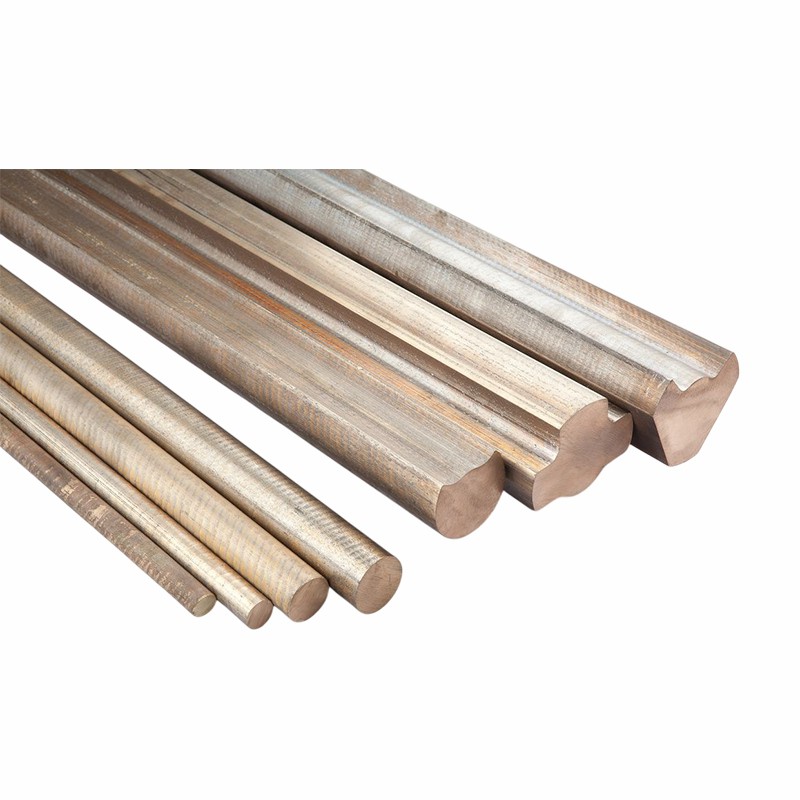

On average, the density of bronze ranges from about 7.4 to 8.9 grams per cubic centimeter ((g/cm^{3})). Let's say we have a bronze alloy with a density (\rho) in (g/cm^{3}). To convert it to (kg/m^{3}), we multiply by 1000. So, if (\rho = 8.5g/cm^{3}), then in (kg/m^{3}), it's (8500kg/m^{3}).
Calculating the weight per meter
Once you have the cross - sectional area (A) (in (m^{2})) and the density (\rho) (in (kg/m^{3})), you can calculate the weight (W) of the tube per meter using the formula (W = A\times\rho).
Let's take an example. Suppose we have a square - shaped bronze tube with an outer side length (a = 0.1m) and an inner side length (b = 0.08m). First, we calculate the cross - sectional area:
[
\begin{align*}
A&=a^{2}-b^{2}\
&=(0.1)^{2}-(0.08)^{2}\
&=0.01 - 0.0064\
&=0.0036m^{2}
\end{align*}
]
If the density of the bronze alloy (\rho = 8500kg/m^{3}), then the weight per meter (W) is:
[
\begin{align*}
W&=A\times\rho\
&=0.0036\times8500\
& = 30.6kg/m
\end{align*}
]
Why knowing the weight per meter matters
Knowing the weight of a bronze shaped tube per meter is essential for several reasons. In construction, it helps in structural design. Engineers need to know the weight to ensure that the structure can support the load. If the tubes are too heavy, it might require additional support, which can increase the cost of the project.
In transportation, the weight per meter affects shipping costs. Heavier tubes will cost more to transport, so it's important to factor this in when budgeting for a project.
Comparing with other bronze products
It's also interesting to compare the weight of bronze shaped tubes with other bronze products like Bronze Square Rod and Bronze Shaped Rod. A solid bronze rod will generally weigh more per meter than a tube of the same outer dimensions because the rod doesn't have a hollow center. However, the tube might offer better strength - to - weight ratio in some applications, making it a more cost - effective choice.
Quality and weight
The weight of a bronze shaped tube can also be an indicator of its quality. A tube that is significantly lighter or heavier than expected might have manufacturing defects, such as inconsistent wall thickness or an incorrect alloy composition. So, when you're buying Bronze Shaped Tube, it's a good idea to check the weight per meter against the specifications provided by the supplier.
Conclusion
So, there you have it! The weight of a bronze shaped tube per meter depends on the cross - sectional area and the density of the bronze alloy. By understanding these factors, you can make more informed decisions when it comes to choosing the right tube for your project.
If you're in the market for high - quality bronze shaped tubes, we're here to help. Whether you need a specific shape, size, or alloy, we can provide you with the best products at competitive prices. Don't hesitate to reach out to us for more information or to start a procurement discussion.
References
- "Materials Science and Engineering: An Introduction" by William D. Callister Jr.
- Engineering handbooks on copper and copper alloys.


