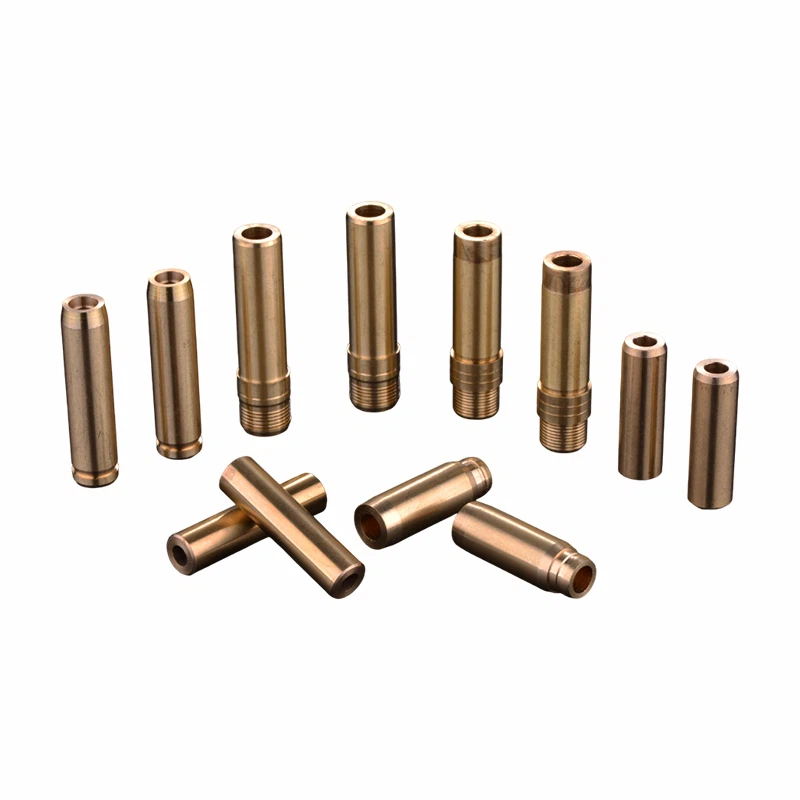
What is the maximum allowable load for a bronze square rod?
As a supplier of Bronze Square Rods, I often encounter inquiries from customers about the maximum allowable load these rods can bear. Understanding this crucial aspect is essential for ensuring the safe and efficient use of bronze square rods in various applications. In this blog post, I'll delve into the factors that determine the maximum allowable load of a bronze square rod, and how you can make informed decisions when selecting the right rod for your project.
Understanding the Basics of Bronze Square Rods
Before we dive into the maximum allowable load, let's briefly introduce what bronze square rods are. A Bronze Square Rod is a type of copper - alloy rod with a square cross - section. Bronze is an alloy primarily composed of copper and tin, and it may also contain other elements such as zinc, lead, or phosphorus, depending on the specific application requirements.
Bronze has several desirable properties that make it a popular choice for many industries. It offers excellent corrosion resistance, good machinability, high strength, and wear resistance. These properties make bronze square rods suitable for a wide range of applications, including machinery parts, bearings, bushings, and decorative elements.
Factors Affecting the Maximum Allowable Load
The maximum allowable load of a bronze square rod is determined by several factors. Let's explore each of these factors in detail:
Material Properties
The composition of the bronze alloy plays a significant role in determining its strength and load - bearing capacity. Different bronze alloys have different mechanical properties. For example, phosphor - bronze, which contains phosphorus in addition to copper and tin, has high strength and excellent fatigue resistance. This makes it suitable for applications where the rod will be subjected to cyclic loading. On the other hand, leaded bronze has better machinability but may have slightly lower strength compared to some other bronze alloys.
The yield strength and ultimate tensile strength of the bronze alloy are key parameters. The yield strength is the stress at which the material begins to deform plastically, while the ultimate tensile strength is the maximum stress the material can withstand before breaking. When calculating the maximum allowable load, engineers typically use a fraction of the yield strength to ensure a safety margin.


Cross - Sectional Area
The size of the square cross - section of the rod directly affects its load - bearing capacity. According to the basic principles of mechanics, the stress in a rod under axial load is given by the formula $\sigma=\frac{F}{A}$, where $\sigma$ is the stress, $F$ is the applied load, and $A$ is the cross - sectional area. A larger cross - sectional area can withstand a higher load without exceeding the allowable stress of the material. For example, a bronze square rod with a side length of 20 mm will have a larger cross - sectional area ($A = s^2=20^2 = 400\ mm^2$) compared to a rod with a side length of 10 mm ($A = 10^2=100\ mm^2$), and thus can bear a higher load.
Length of the Rod
The length of the bronze square rod also influences its maximum allowable load, especially in cases where the rod is subjected to bending or buckling. Longer rods are more prone to buckling under compressive loads. The critical buckling load of a column (such as a bronze square rod) is given by Euler's formula $P_{cr}=\frac{\pi^{2}EI}{(KL)^{2}}$, where $E$ is the modulus of elasticity of the material, $I$ is the moment of inertia of the cross - section, $K$ is the effective length factor, and $L$ is the length of the rod. As the length of the rod increases, the critical buckling load decreases, meaning that the rod can withstand a lower compressive load before buckling.
Type of Loading
The way the load is applied to the bronze square rod is another important factor. There are different types of loading, including axial loading (tension or compression), bending, shear, and torsion. Each type of loading requires a different approach to calculating the maximum allowable load.
- Axial Loading: In axial tension or compression, the load is applied along the axis of the rod. The maximum allowable load is calculated based on the cross - sectional area and the allowable stress of the material.
- Bending: When a rod is subjected to bending, the stress distribution across the cross - section is non - uniform. The maximum stress occurs at the outer fibers of the rod. The maximum allowable load in bending is determined by the bending moment capacity of the rod, which depends on the cross - sectional shape, material properties, and the span of the rod.
- Shear Loading: Shear forces act parallel to the cross - section of the rod. The maximum allowable shear load is related to the shear strength of the material and the cross - sectional area.
- Torsion: Torsional loading causes the rod to twist. The maximum allowable torsional load is determined by the torsional strength of the material and the polar moment of inertia of the cross - section.
Calculating the Maximum Allowable Load
Calculating the maximum allowable load for a bronze square rod requires a detailed understanding of the above - mentioned factors. In most cases, engineers use established engineering formulas and standards to perform these calculations.
For simple axial loading, if the allowable stress of the bronze alloy is $\sigma_{allow}$ and the cross - sectional area of the square rod is $A$, the maximum allowable axial load $F_{allow}$ is given by $F_{allow}=\sigma_{allow}A$.
In more complex cases, such as bending or combined loading, finite element analysis (FEA) software can be used to accurately predict the stress distribution and the maximum allowable load. FEA takes into account the geometry of the rod, material properties, and the type of loading to provide a detailed analysis of the structural behavior.
Applications and Maximum Allowable Load Considerations
Let's take a look at some common applications of bronze square rods and how the maximum allowable load is considered in each case:
Machinery Parts
In machinery, bronze square rods are often used as shafts or structural components. For example, in a power transmission system, a bronze square rod may be used as a drive shaft. The maximum allowable load in this case is determined by the torque that the shaft needs to transmit. The torsional strength of the bronze alloy and the diameter of the shaft (related to the cross - sectional area) are crucial factors. Engineers must ensure that the maximum torque transmitted by the shaft does not exceed the allowable torsional load of the rod to prevent failure.
Bearings and Bushings
Bronze square rods are also used to manufacture bearings and bushings. In these applications, the rod is subjected to radial loads from the rotating shaft. The maximum allowable load is determined by the bearing pressure, which is the ratio of the applied load to the projected area of the bearing surface. The material properties of the bronze, such as its hardness and wear resistance, also play a role in determining how much load the bearing can withstand over its service life.
Other Shapes of Bronze Rods
In addition to Bronze Square Rods, we also supply Bronze Shaped Rod and Bronze Round Bar. Each shape has its own advantages and is suitable for different applications. For example, bronze round bars are often used in applications where a circular cross - section is required, such as in shafts and pins. The principles for calculating the maximum allowable load for these other shapes are similar to those for square rods, but the cross - sectional properties (such as moment of inertia and polar moment of inertia) are different.
Conclusion and Call to Action
Understanding the maximum allowable load for a bronze square rod is crucial for ensuring the safety and performance of your projects. By considering factors such as material properties, cross - sectional area, length, and type of loading, you can make informed decisions when selecting the right bronze square rod for your application.
As a professional supplier of bronze square rods, we have a wide range of products with different sizes and alloy compositions to meet your specific requirements. Our team of experts can assist you in calculating the maximum allowable load for your application and selecting the most suitable rod. If you are interested in purchasing bronze square rods or have any questions about their load - bearing capacity, please feel free to contact us for further discussion and procurement.
References
- Budynas, R. G., & Nisbett, J. K. (2011). Shigley's Mechanical Engineering Design. McGraw - Hill.
- Young, W. C., Budynas, R. G., & Sadegh, A. (2002). Roark's Formulas for Stress and Strain. McGraw - Hill.