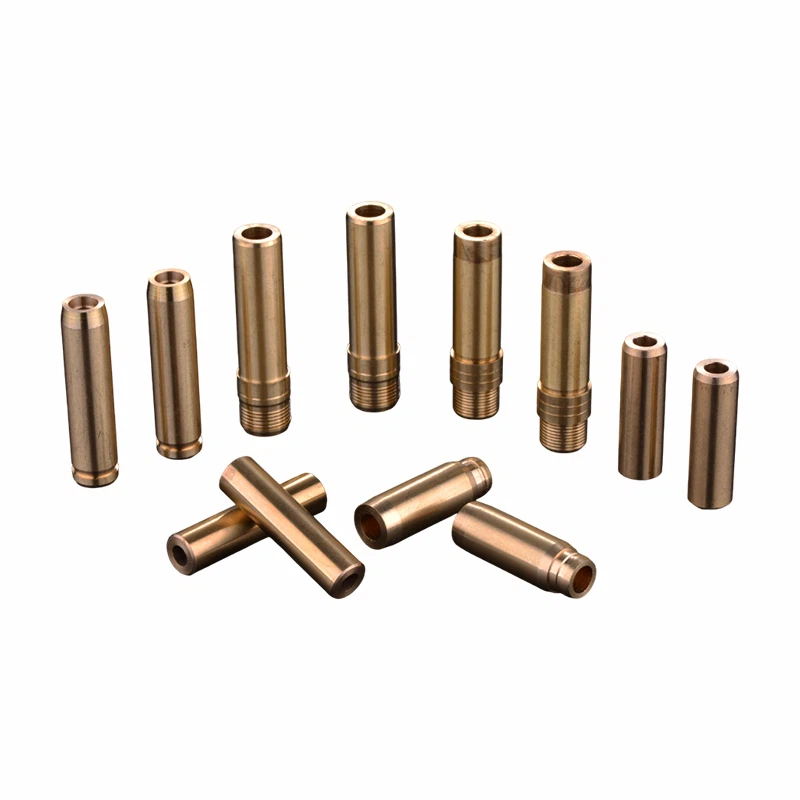
Hey there! As a supplier of Valve Guide Pipes, I often get asked about all sorts of technical stuff related to these parts. One question that pops up quite a bit is, "What is the expansion coefficient of a valve guide pipe?" Let's dive right into it and break it down in a way that's easy to understand.
First off, what exactly is a valve guide pipe? Well, it's a crucial component in an engine. It guides the valve stem, ensuring that the valve moves up and down smoothly in a straight line. This helps in the proper intake of air - fuel mixture and the exhaust of burnt gases. You can learn more about Valve Guide Pipe on our website.
Now, let's talk about the expansion coefficient. The expansion coefficient, also known as the coefficient of thermal expansion, is a measure of how much a material expands or contracts when its temperature changes. Every material has its own unique expansion coefficient, and for valve guide pipes, this property is super important.
Why is it so important? In an engine, the temperature can vary greatly. When the engine is running, it gets really hot, and when it's off, it cools down. The valve guide pipe needs to be able to handle these temperature changes without getting damaged or losing its functionality. If the expansion coefficient is too high, the valve guide pipe might expand too much when the engine heats up. This could lead to a tight fit between the valve stem and the guide pipe, causing excessive wear and tear, and even seizing in extreme cases. On the other hand, if the expansion coefficient is too low, the valve guide pipe might not expand enough, leading to a loose fit and poor sealing, which can affect the engine's performance.
Most valve guide pipes are made from materials like copper alloys. Copper alloys are popular because they have good thermal conductivity and relatively stable expansion coefficients. For example, some common copper - based valve guide pipes have an expansion coefficient in the range of about 16 - 18 x 10^(-6) per degree Celsius. This means that for every one - degree Celsius increase in temperature, the length of the valve guide pipe will increase by about 16 - 18 millionths of its original length.
Let's compare valve guide pipes with other related auto parts. Take Cooper Thrust Bearing for instance. Thrust bearings are used to handle axial loads in an engine. The expansion coefficient of thrust bearings also matters, but in a different way. They need to maintain their shape and fit within the engine's structure as the temperature changes. If they expand or contract too much, it can lead to misalignment and reduced bearing life.
Another related part is the Floating Bearing. Floating bearings are designed to allow some movement while supporting the rotating parts. Their expansion coefficient affects how well they can maintain this floating action. If they expand too much, they might get stuck, and if they contract too much, they might not provide enough support.
When it comes to manufacturing valve guide pipes, we pay a lot of attention to the expansion coefficient. We carefully select the materials and use advanced manufacturing processes to ensure that the expansion coefficient is within the optimal range. We conduct a series of tests on the valve guide pipes to measure their expansion coefficient accurately. One common test method is the dilatometry test. In this test, we heat the valve guide pipe and measure the change in its length using a precise measuring device. By analyzing the data from these tests, we can make sure that the valve guide pipes we supply meet the high - quality standards required by the automotive industry.
In addition to the material itself, the design of the valve guide pipe also plays a role in how it responds to temperature changes. For example, the thickness of the pipe walls and the shape of the pipe can affect its expansion behavior. We use computer - aided design (CAD) and finite element analysis (FEA) to optimize the design of the valve guide pipes. These tools help us predict how the pipes will expand and contract under different temperature conditions and make adjustments to the design as needed.
So, if you're in the automotive industry and looking for high - quality valve guide pipes, you know that the expansion coefficient is a key factor to consider. At our company, we've got years of experience in manufacturing valve guide pipes with the right expansion coefficient. Our products are reliable and can withstand the harsh temperature conditions in an engine.
Whether you're an engine manufacturer, a repair shop, or someone involved in the automotive aftermarket, we're here to provide you with the best valve guide pipes. We understand the importance of this small but crucial part in the overall performance of an engine. If you're interested in our valve guide pipes or have any questions about the expansion coefficient or other technical aspects, don't hesitate to get in touch with us. We're more than happy to have a chat and discuss your specific needs. Let's work together to ensure that your engines run smoothly and efficiently.
References


- Automotive Handbook, various editions
- Journals related to automotive engineering and materials science